
Currently in development · 2026–2028
People. Spaces. Things.One OS.
An operating layer for buildings.
Zacot is a Building Operating System designed to connect how buildings are designed, operated, experienced and improved — bringing spaces, systems, data and people onto common ground.
Residents · Visitors · Operators · Service teams
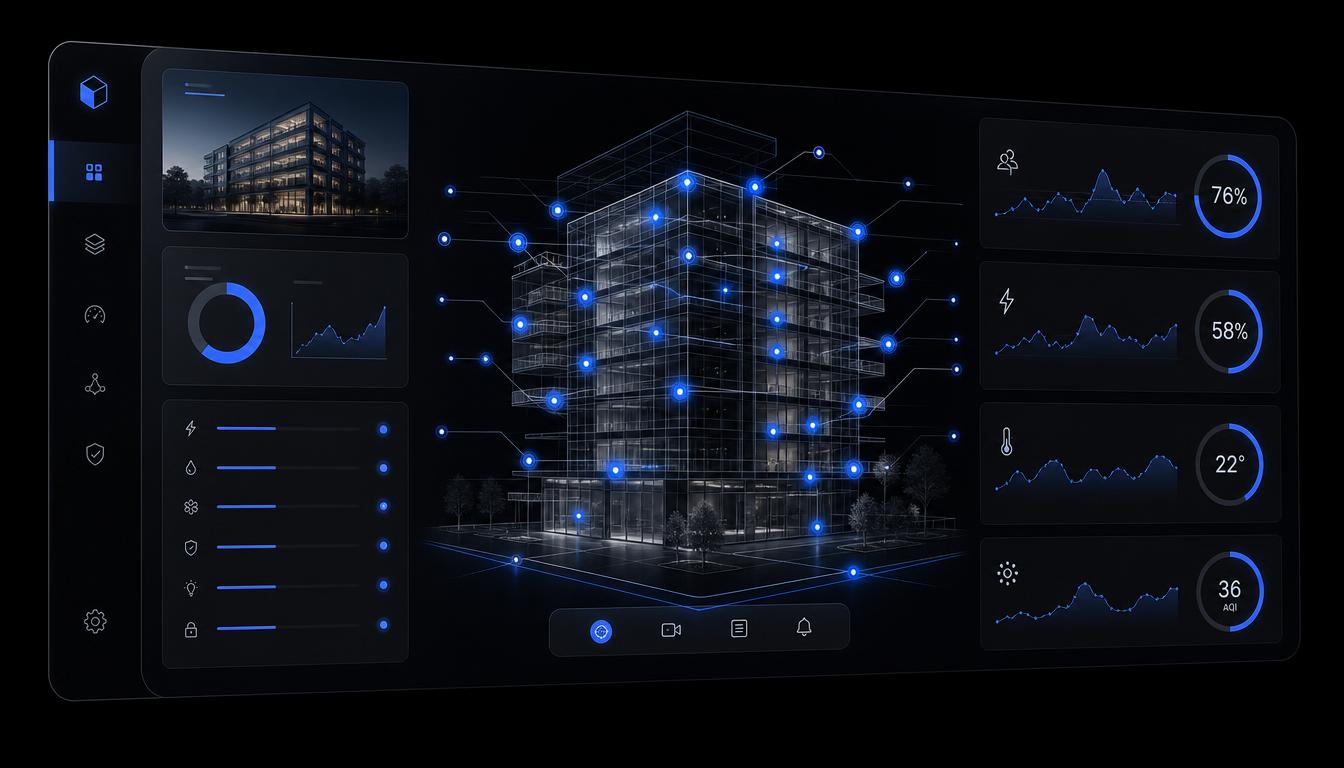
What is Zacot
Buildings are getting complex.
The systems behind them are not connected.
Zacot is a Building Operating System: one common layer where the physical building meets its digital and operational intelligence.
Design data
lives in BIM.
Building systems
run independently.
Devices
generate isolated data.
Operations teams
rely on different tools.
Occupants
interact through yet another layer.
People
- Occupants
- Operators
- Owners
- Service teams
Spaces
- Rooms
- Floors
- Zones
- Whole buildings
Things
- HVAC
- Lighting
- Access
- Energy
- Sensors
One OS
- Identity
- Context
- Rules
- Coordination
The Zacot intelligence model
Sense. Understand. Decide.
Act. Learn.
A continuous loop that turns raw building signals into contextual awareness, decisions and coordinated action — and feeds every outcome back into the system.
Sense
Collect real-time data from people, spaces, devices and building systems.
Understand
Create contextual awareness of what is happening inside the building.
Decide
Apply rules, context and analytics to determine the right response.
Act
Orchestrate devices, systems and workflows.
Learn
Continuously improve building performance using operational data.
Sense→Understand→Decide→Act→Learn
From building systems to Building OS
Five stages of a
building's evolution.
Most buildings today sit somewhere between the first two stages. Zacot is being developed to make the later ones reachable.
Traditional Building
Physical spaces, independent systems, manual operations, fragmented data.
Connected Building
Systems begin exchanging data.
Intelligent Building
The building understands its own patterns and conditions.
Adaptive Building
The building adjusts its operation based on context.
Autonomous Building
The building increasingly optimizes and coordinates its own operation within defined rules and human oversight.
Why Zacot exists
Fragmentation is the
real building problem.
A building is delivered by many disciplines and operated by many vendors. Each one arrives with its own tooling, its own data and its own idea of what the building is.
The result is a building nobody can read end to end — hard to understand, harder to improve, and almost impossible to evolve after handover.
Zacot is being developed as the common operating layer where these systems can share context and, in time, coordinate their actions.
Today
→ Each system knows only its own part of the building.
With Zacot
Built across disciplines
Architecture meets
technology and building systems.
Zacot is being developed through the collaboration of professionals from architecture, software technology and building systems engineering.
We believe the next generation of buildings cannot be created by software alone. It requires an understanding of how buildings are designed, how people experience spaces, how physical systems operate, and how data and intelligence can orchestrate them together.
Architecture
Understanding spaces
- Building design
- Spatial experience
- Building lifecycle
- Sustainability
- Human-centric design
Technology
Creating the digital layer
- Cloud platform
- Building data
- Digital twin
- APIs
- AI & analytics
- Applications
Systems
Orchestrating the physical building
- IoT
- Sensors
- HVAC
- Lighting
- Access control
- Energy systems
- Autonomous operations
The Zacot operating layer
Zacot sits above
individual building systems.
Not another system next to the others — a layer that gives all of them the same picture of the building.
Experience Layer
Operators · Owners · Tenants · Occupants · Service providers
ZACOT — Building OS
Identity · Context · Rules · Orchestration · Analytics
Data Layer
BIM · Digital twin · Real-time sensor data · Operational history
Systems Layer
HVAC · Lighting · Energy · Access · Water · Safety · Elevators · Sensors
Physical Layer
Buildings · Rooms · Equipment · Infrastructure
What we are building
The capabilities
of the Building OS.
Each capability is currently in research and development. None of them is a finished product yet.
Building Identity
A persistent digital identity for spaces, systems, assets and devices.
Operational Context
Understand what is happening inside the building — and why it is happening.
System Orchestration
Let separate building systems coordinate through shared rules and shared context.
Digital Twin
Keep physical spaces and their digital representation in step with each other.
Resource Intelligence
Read energy, water, environmental conditions and infrastructure usage as one picture.
Human Interaction
Let occupants and operators interact with the building naturally.
Operational Intelligence
Turn building data into decisions and recommendations, and eventually into actions.
Open Integration
Connect existing third-party systems instead of replacing them.
Open ecosystem
Built to connect,
not replace.
Zacot is being designed as an open layer capable of working with existing building technologies rather than replacing them.
Our goal is to connect hardware, software and infrastructure from multiple vendors through a common building platform.
Research direction
Researching the path
toward autonomous buildings.
Zacot begins as an R&D programme. These are the open questions we are working through — not features we claim to have solved.
Self-awareness
How can a building understand its own operational state?
Interpretation
How can spatial data, sensor data and human behaviour be read together?
Learning
How can a building learn from its own operational history?
Boundaries of delegation
Which operational decisions can safely be delegated to software?
Human oversight
How do people stay in control as buildings become more autonomous?
Resource impact
How much energy, operational cost and environmental impact can a Building OS actually remove?
Pilot building
From concept to a real building.
Zacot will not be developed only in a software environment.
As part of the project, we plan to select a pilot building where architecture, building systems, orchestration and the Zacot platform can be designed and tested together.
The pilot will become a living laboratory for developing and validating the Building OS concept.
A living laboratory for the future of buildings.
Roadmap
The Road to a Building OS
From research to software. From software to a real building. From a real building to measurable results.
Phase 01
Research & System Development
Q3 2026 → Q4 2027
Phase 02
Pilot Deployment
Q1 → Q2 2028
Phase 03
Monitoring & Validation
Q3 → Q4 2028
Research & Build
Develop the Building OS.
Research, design and build the Zacot Building Operating System — architecture, digital twin, data model and intelligence.
- Building OS architecture
- Digital Twin
- BIM integration
- IoT and building system integration
- Unified data model
- Intelligence and decision engine
- System orchestration
Deploy
Bring it into a real building.
Deploy Zacot into a real building and activate intelligent and autonomous operations.
- Deploy Zacot into a real building
- Integrate building systems
- Configure sensors and operational workflows
- Activate intelligent and autonomous use cases
Prove
Measure how it performs in the real world.
Collect real operational data and validate autonomous building performance.
- Collect real operational data
- Measure energy and resource efficiency
- Analyze occupant experience
- Validate autonomous operations
- Improve algorithms and building intelligence
Research → Build → Prove
From research to software. From software to a real building. From a real building to measurable results.
Project status
Zacot is currently under development.
The project entered its research and development phase in 2026. Our objective is to research, design and develop the Zacot Building OS, then validate it through a real-world pilot project in 2028.
Current phase
Research & System Development
Project period
Q4 2026 → Q4 2028
Next milestone
Pilot Project Selection
Phase 01
Research & Build
Q4 2026 — Q4 2027
Develop the Zacot Building OS.
Phase 02
Deploy
Q1 2028 — Q2 2028
Bring it into a real building.
Phase 03
Prove
Q3 2028 — Q4 2028
Measure real-world performance.
Research → Build → Prove
From research to software. From software to a real building. From a real building to measurable results.
Collaboration
Built
across disciplines.
Zacot is being developed through collaboration between people working in architecture, building engineering, software, control systems, data and emerging technologies.
Buildings are not purely software systems. A Building Operating System has to understand the digital layer and the physical environment it governs equally well.
Future vision
Buildings should not
only be connected.
They should understand how they operate.
The long-term ambition of Zacot is to explore what happens when a building gains a common operating layer — one able to read spaces, systems, resources and human activity together.
The destination is not more dashboards.
It is buildings that can increasingly understand, adapt and operate themselves.
From connected buildings to autonomous buildings.